
Book your stay

Two people can weigh exactly the same and have very different bodies. One may have more muscle, the other more fat. To find out, a nutritionist can use bioelectrical impedance analysis, which estimates water, lean mass and fat mass, and skinfold measurement, which measures the thickness of folds of skin. These are simple, non-invasive tests that help track changes in the body over time. At the Lucia Magnani Health Clinic they are part of the nutritional assessment in the Weight Loss and Evergreen Long Life Formula® programmes.
The weight we read on the scales is the sum of fat, muscle, bone, organs and water. Body composition indicates the proportions of these components.
Body mass index, or BMI, relates weight to height but does not distinguish fat from muscle. The new framework for diagnosing obesity proposed in 2024 by the European Association for the Study of Obesity recognises that BMI alone is not sufficient and that body fat distribution has a substantial effect on health. For this reason it adds the waist-to-height ratio and an assessment of the person’s health conditions to BMI.
NICE, the UK body that produces health guidance, also advises adults to keep their waist measurement to less than half their height.
Bioelectrical impedance analysis uses a very weak electric current that is usually not felt. The electrodes may be applied to the skin or built into the device, on which you rest your hands and feet.
The current passes through the body and meets different resistance depending on the tissue. Tissues rich in water conduct electricity better. The device records this response and uses formulas to estimate how much water, lean mass and fat mass the body contains.
The report varies with the device. It may show the weight and percentage of fat, lean mass, total body water and other values. The guidelines of the European Society for Clinical Nutrition and Metabolism (ESPEN) note that the method reliably estimates lean mass and body water when population- and age-appropriate equations and standardised procedures are used, in people without significant fluid imbalances.
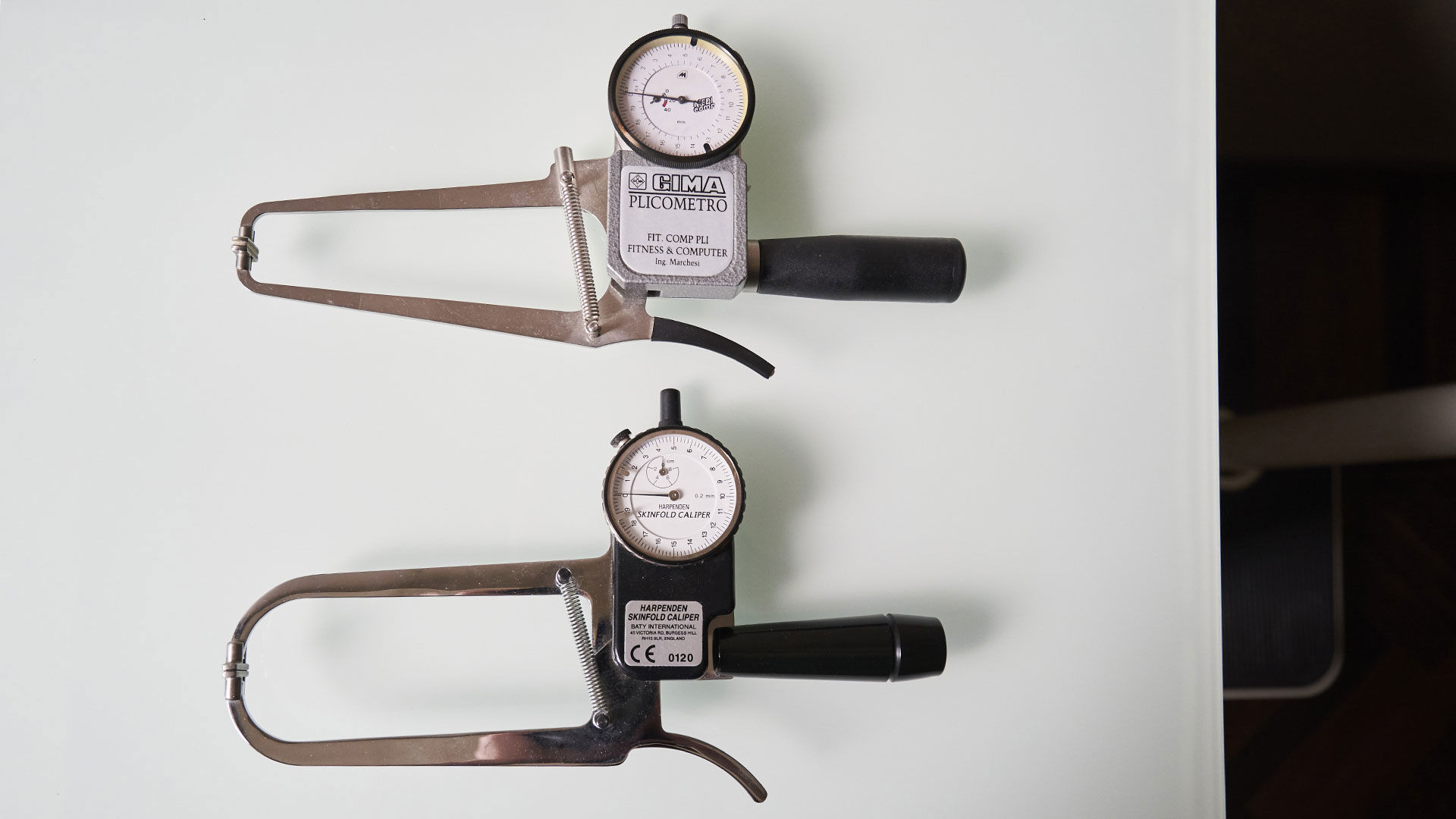
Skinfold measurement assesses subcutaneous fat, the fat just beneath the skin. The nutritionist uses a skinfold caliper, a pincer that measures in millimetres the thickness of a fold of skin together with the fat underneath.
Measurements are taken at specific sites, for example on the arms, abdomen, back and thighs. Formulas are then used to estimate the body’s fat percentage.
The result depends greatly on who performs the test. It is therefore best for measurements to be taken by the same person and always at the same sites.
| Feature | Bioimpedance analysis | Skiinfold measurement |
| What it measures | How tissues respond to an electric current | The thickness of skinfolds |
| What it estimates | Water, lean mass and fat mass | Subcutaneous fat and fat percentage |
| Main influencing factor | Hydration status | The experience of the person measuring |
| Useful for | Tracking certain values over time | Comparing skinfold thickness |
The two techniques can be used together, because they provide different information. Neither is perfect. Interpreting the data also requires weight, waist circumference, age, health status and the person’s habits.
When comparing results, the most important thing is to understand how body composition changes over time. Weight loss, for example, may be due to a loss of fat, fluids or lean mass. For this reason the values should be interpreted by the nutritionist.
Fat mass is the body’s share of fat, expressed in kilograms or as a percentage. Lean mass includes everything else, namely muscle, bone, organs and water, so it is not the same as muscle mass alone. Body water is a major part of lean mass and varies with hydration. The nutritionist reads these values together, never one at a time.
Visceral fat is the fat that builds up in the abdomen, around the organs. Excess visceral fat is linked to a higher risk of metabolic and cardiovascular problems. Skinfold measurement does not measure it, because it only assesses fat under the skin. Some bioimpedance devices display a visceral fat index, but that figure comes from a calculation rather than a direct measurement. To assess abdominal fat, the doctor may also consider waist circumference and the waist-to-height ratio.
The amount of water in the body changes during the day. Drinking, eating, exercising or sweating shifts fluids, so the figures can vary even when the tissues have not changed. The ESPEN guidelines note that bioimpedance analysis works well in people with a stable water and electrolyte balance.
• Have the tests done at the same time of day and in similar conditions.
• Follow the instructions you receive on food, drinks and physical activity in the hours before the test.
• Compare results obtained with the same device, because different devices and equations can give different values.
• For skinfold measurement, have the measurements taken, where possible, by the same person and at the same sites.
No. The current is very weak and usually cannot be felt. The test takes a few minutes and follows the device’s safety rules.
Usually not. You feel slight pressure from the caliper on the skin, and the test takes a few minutes.
It is best to follow the instructions of the person performing the test. A recent meal can change the measurement conditions and make results less comparable.
It depends on what you want to know. Bioimpedance analysis estimates more components of the body, while skinfold measurement measures the thickness of fat under the skin. The nutritionist may decide to use both.
Not always. Weight can drop because of a loss of fat but also of fluids or lean mass. Understanding what is happening requires several parameters, compared over time.
It depends on the goal and the person’s situation. The nutritionist decides when to take a new measurement and avoids checks too close together, which may be affected by normal fluid fluctuations.
It is advisable to talk to a doctor if your weight changes a lot for no obvious reason, if your waist measures more than half your height, or if tiredness, weakness or swelling persist. Bioimpedance analysis and skinfold measurement describe body composition but are not diagnostic tests. Their values should be interpreted by a professional together with your medical history.
In the Weight Loss programme at the Lucia Magnani Health Clinic in Castrocaro Terme, the nutritional assessment includes a specialist consultation with initial and final skinfold measurement and the measurement of fat mass and lean mass with bioimpedance analysis.
The data are used to compare body composition at different stages of the programme. They are read by the professional, who considers them together with the person’s medical history, diet and physical activity. On this basis a dietary plan is defined for the stay and another one to follow at home, in line with the approach to nutrition of the Long Life Formula® Method developed by Lucia Magnani.
The programme also includes oxidative stress analysis, a medical check-up with a physiatric examination and two daily sessions of physical activity with a personal trainer, alternating between the Health Performance Training Center and thermal water classes. Beauty treatments and daily access to the Health SPA complete the experience.
To learn about the consultations, tests and activities included, you can consult the Weight Loss Long Life Formula® programme page.